
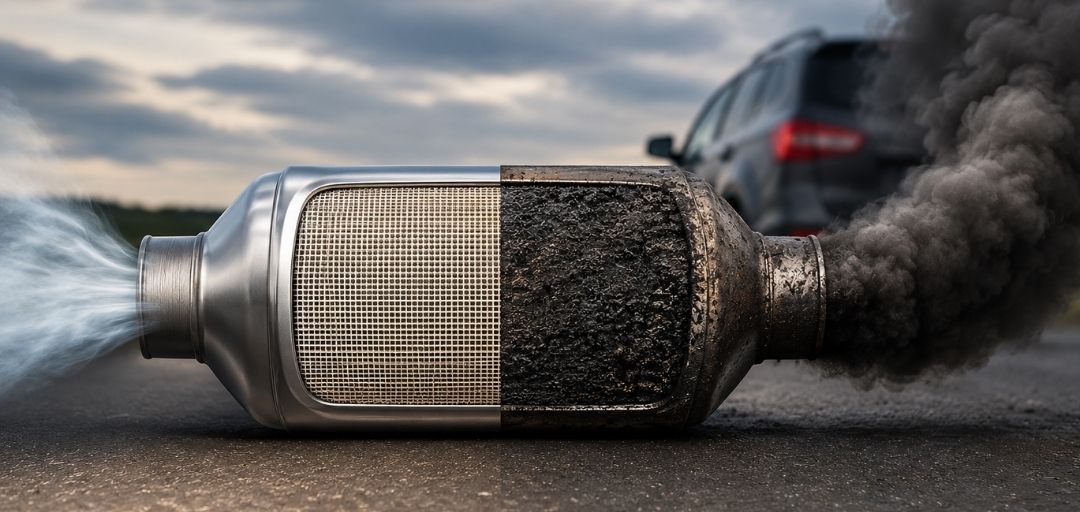
A blocked diesel particulate filter is one of the more common reasons diesel owners see their fuel costs go up with no clear explanation. The DPF sits quietly in your exhaust system doing its job, and most drivers never think about it until something goes wrong. By then, the engine has often been running harder than it should for quite a while.
This blog covers what happens inside your engine when the DPF gets blocked, why that leads to higher fuel use, and what the fix looks like.
What Does the DPF Actually Do?
The diesel particulate filter sits in your exhaust system. Its job is to catch soot and fine particles produced when diesel burns. Without it, those particles go straight into the air. Modern diesel vehicles have had DPFs fitted as standard since around 2009, when stricter emissions rules came into effect.
The filter traps soot and holds it. Over time it fills up. To keep working properly, it has to clear itself out through a process called regeneration. When that goes to plan, the soot burns off and the filter empties again. When it does not, soot builds up and the filter starts to block.
Why a Blocked DPF Makes Your Engine Work Harder
The Backpressure Problem
When the DPF gets clogged, exhaust gases cannot move through the filter freely. Pressure builds up behind it in the exhaust system. This is called backpressure, and it is the main reason a blocked filter hurts fuel economy.
The engine has to push harder to force exhaust gases through a restricted filter. That takes more energy. More energy means more fuel burned, even though the vehicle is doing exactly what it was doing before.
How Your Car Responds
Every modern diesel has a computer that keeps an eye on how the engine is running. When the filter blocks up and pressure rises in the exhaust, the computer picks up on it. To keep the engine running normally, it starts using more fuel to make up the difference.
So the engine is already under more strain, and the car is also burning extra fuel on top of that. Nothing has changed about where you are driving or how far. You are just using more fuel to do the same trip.
The Fuel Cost of a Blocked DPF
Here are the main ways a blocked filter drains extra fuel:
- Harder engine work. The engine burns more fuel just to maintain normal performance when exhaust flow is restricted.
- More frequent self-cleaning attempts. When the filter cannot clear itself naturally, the car tries to do it manually by burning extra fuel to heat up the exhaust. The more often this happens, the more fuel it uses, and if those attempts keep failing, the blockage keeps growing.
- Turbo inefficiency. The turbocharger needs exhaust gases flowing freely to work properly. A blocked DPF restricts that flow. When the turbo cannot do its job, the engine loses power and the car compensates by using more fuel.
- Limp mode fuel waste. If the blockage gets bad enough, the car switches into a reduced power mode to protect the engine. Output is cut right back, and you end up using more fuel to cover less ground.
Studies have found that a partially or fully blocked DPF can increase fuel consumption by around 10 to 15 percent. For a driver covering average distances, that is a real and measurable cost over weeks and months.
The Oil Dilution Problem
There is a secondary issue that comes with a blocked DPF that most drivers do not hear about. When the car tries to clear the filter, it burns extra fuel to heat up the exhaust. If the trip is too short, that process does not finish. The extra fuel has nowhere to go.
Over time, that unburnt fuel can work its way into the engine oil. Once that happens, the oil does not protect the engine as well as it should. Parts wear faster, and what started as a fuel problem becomes a more expensive one.
Signs Your Fuel Increase Is DPF-Related
A blocked DPF does not always make itself obvious straight away. Fuel consumption going up is easy to put down to other things, especially if the increase is gradual.
These are the signs that often show up together when the DPF is the issue:
- DPF warning light on the dash. This usually appears when the filter is around 45 percent full and struggling to clear itself through normal driving.
- Noticeable drop in power. Sluggish acceleration, especially on hills or when overtaking, is a common symptom.
- More frequent fuel stops. If your fill-up schedule has shifted and your driving habits have not, something is likely off.
- Black or thicker than usual exhaust smoke. This can mean the filter is full and particles are passing through unfiltered.
- Unusual exhaust smell. Trapped soot and unburnt fuel can produce a noticeable smell from the exhaust.
- Vehicle entering limp mode. This is a late-stage sign. The ECU restricts engine output to prevent further damage.
The DPF warning light is worth taking seriously when it first appears. The longer it stays on without action, the harder the blockage becomes to clear through normal driving.
Why Short Trips Are a Big Part of the Problem
A lot of DPF blockages come down to driving habits. Short trips are the main cause. When you only drive for 10 or 15 minutes at a time, the exhaust never gets hot enough to burn off the soot that has built up. So it just sits there and accumulates.
The filter clears itself naturally on longer drives at a decent speed. It can also try to clear itself automatically when soot levels get too high, but that process needs the car to keep moving long enough to finish. If you pull up before it is done, the warning light stays on and the soot stays put. Do that regularly and the blockage gets worse over time, along with the fuel costs.
What Happens If You Ignore It
Leaving a blocked DPF alone does not just cost more in fuel. The damage can spread. Here is what tends to happen as the problem gets worse:
- Turbo damage. Prolonged backpressure strains the turbocharger. Turbo replacement in Australia can cost anywhere from $2,000 to $5,500, sometimes more depending on the vehicle.
- Injector wear. Extra fuel injection during failed regeneration cycles puts stress on injectors over time.
- Engine damage. Sustained strain on the engine, combined with oil diluted by unburnt fuel, shortens engine life.
- Complete DPF failure. A filter that has been blocked for too long may not be cleanable. At that point, replacement is the only option, which is considerably more expensive than a cleaning service.
Most of this is avoidable if the filter gets attention early. The damage tends to compound the longer it is left.
What You Can Do About It
Try a Highway Drive First
If the DPF warning light has just come on and the blockage is mild, a longer highway drive can sometimes clear it. Driving at around 80 to 100 km/h for 20 to 30 minutes gives the exhaust enough time to heat up and burn off the soot on its own. Make sure the fuel tank is at least a quarter full, as the car will not attempt to clear the filter when fuel is low.
This only works if the filter is not too far blocked. If the light stays on after a highway run, the blockage has likely gone beyond what driving alone can fix.
Get a Professional DPF Clean
For filters that are too blocked to clear through driving, professional cleaning is the most practical next step. At Australian DPF Centre, the filter is cleaned using specialised equipment that removes soot and ash that cannot be burned off through normal use. The filter is tested before and after the clean to confirm the airflow has been fully restored.
This kind of DPF cleaning removes more than just soot. It also clears the ash that builds up over thousands of kilometres regardless of how well the car is driven. That ash does not burn off on its own, which is why the filter needs a proper clean every so often rather than just relying on the car to manage itself.
How Often Should You Service the DPF?
There is no single answer for every vehicle. It depends on driving habits, engine condition, and the type of oil used. Vehicles that spend most of their time on short urban trips will need more frequent attention than those used primarily for long highway runs.
As a rough guide, DPF cleaning every 80,000 to 100,000 kilometres is a reasonable interval for most diesel vehicles under normal driving conditions. Operators running diesel fleets on urban routes often go shorter between services because stop-start driving accelerates soot buildup.
Using the correct engine oil matters too. Some oils contain additives that leave extra ash deposits in the filter, which increases how often it needs to be cleaned. Always check your vehicle manual for the recommended oil specification.
Does a Clean DPF Improve Fuel Economy?
Yes, in most cases it does. Once the filter is clear, exhaust gases can flow freely again. The engine does not have to work against the restriction. The car stops trying to compensate with extra fuel. The self-cleaning cycles the car runs to manage soot also happen less often and finish properly when they do.
Most drivers notice lower fuel use and a smoother engine response after a professional clean. The car behaves normally again. If the fuel bills have been creeping up and nothing obvious has changed, the DPF is often where the answer sits.
Your Next Step if Fuel Costs Are Climbing
A flow test will show quickly whether the DPF is contributing to higher fuel use. Most of the time, a professional clean is all it takes to bring consumption back down.By removing the built-up soot and ash that driving alone cannot clear, you restore the exhaust system to its original efficiency. This not only puts money back in your pocket at the pump but also prevents the long-term engine strain that leads to far more expensive repairs.
Australian DPF Centre services cars, trucks, buses, motorhomes, and commercial vehicles across Australia. Every clean includes a filter test before and after so you can see the difference. Get in touch with the team to book a service or ask about what suits your vehicle.